
Cuda 1993 Detergent: What We’ve Learned Using About 10,000 Pounds a Year
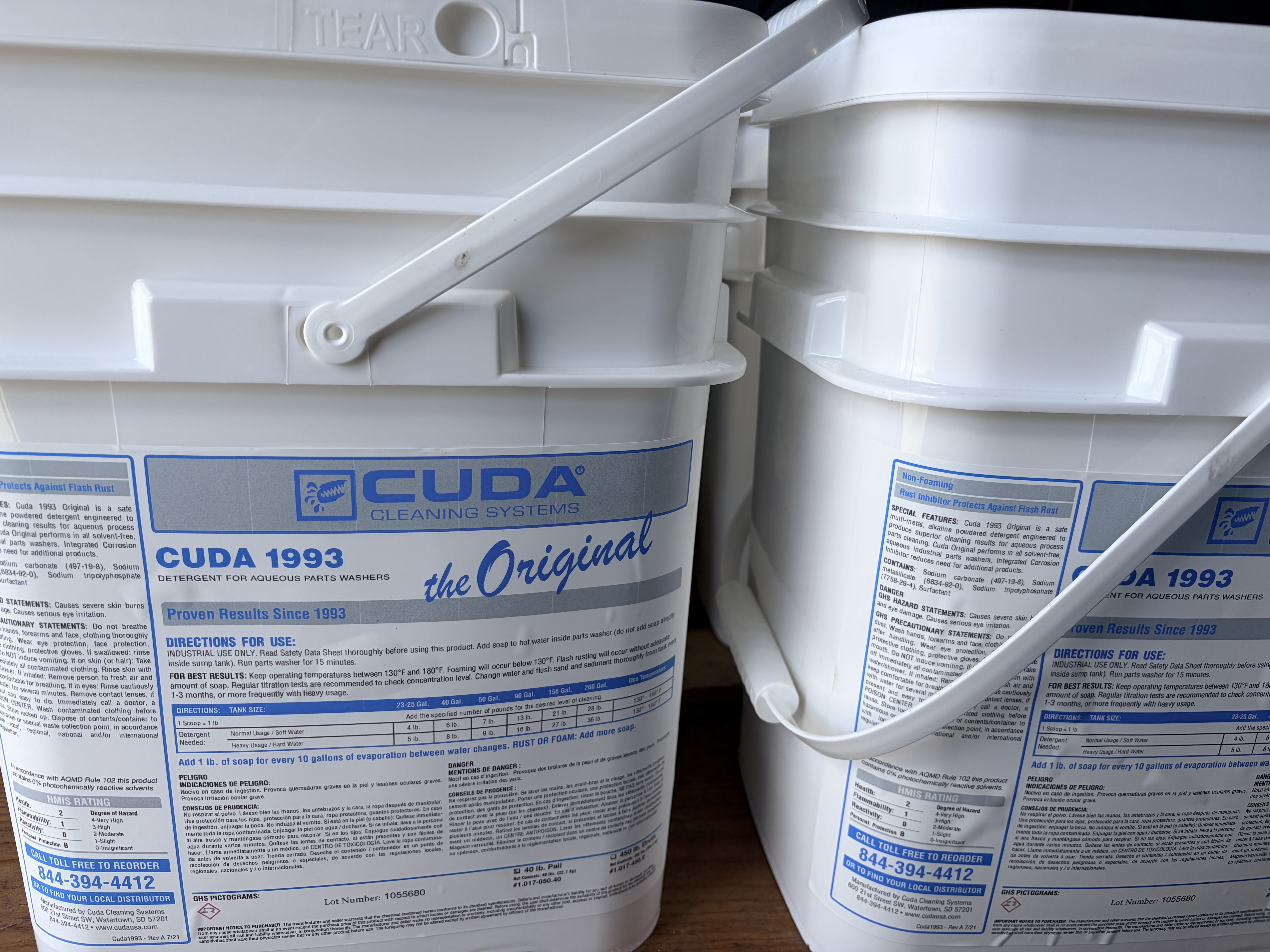
That’s roughly 250 40-pound pails of Cuda 1993 “The Original” used in connection with the Cuda aqueous parts washers we support, service and maintain.
So when a customer asks us whether the detergent they put in their parts washer really makes a difference, our answer is simple:
Absolutely.
A Cuda aqueous parts washer is a complete cleaning system. Water temperature, detergent concentration, spray pressure and flow, wash time, and the condition of the wash solution all work together to produce a clean part.
The washer provides the heat and mechanical cleaning action. Cuda 1993 provides the chemistry that helps break down and remove the grease, oil and industrial contamination on the parts.
And after working with this much detergent in real industrial applications, we have a pretty good idea of what good parts-washing chemistry looks like.
What Is Cuda 1993 “The Original”?
Cuda 1993 is a concentrated alkaline powdered detergent developed specifically for aqueous industrial parts washers.
It is formulated to help remove the oils, grease, grime and other contamination commonly found on industrial components while also providing two features that are particularly important in an automatic spray cabinet:
Corrosion protection and foam control.
Cuda 1993 incorporates a rust inhibitor as well as a defoaming agent into the detergent formulation.
That means you’re not simply adding a cleaner to the water. You’re using chemistry specifically intended to operate in a heated, recirculating aqueous parts-washing system.
Why Not Just Use an Ordinary Degreaser?
One of the important things to understand about an automatic parts washer is that not every detergent or degreaser belongs in one.
A Cuda washer continuously pumps heated cleaning solution through its spray system and directs that solution against the parts being cleaned.
Depending on the Cuda model, that can mean a significant amount of solution being circulated through the machine every minute.
The wrong detergent can create problems.
A product that produces excessive foam, for example, may work perfectly well when applied with a spray bottle or mop but be completely inappropriate inside an automatic spray cabinet.
Likewise, a detergent that provides little corrosion protection may clean the contamination from a steel component but leave freshly exposed metal more susceptible to flash rust.
That’s one reason we prefer using a detergent designed specifically for this type of equipment.
Five Reasons We Like Cuda 1993
1. It Works on the Kind of Contamination We Actually See
The parts going through industrial Cuda washers aren’t usually lightly dusty components.
We see equipment contaminated with:
- Oil
- Grease
- Dirt
- Shop grime
- Industrial residues
- Carbon-based contamination
Cuda 1993 is formulated for these kinds of cleaning applications.
That’s important for maintenance departments, repair shops, manufacturing facilities, steel mills, railroad operations and other industrial users where cleaning parts is part of keeping equipment running.
2. It Helps Protect Clean Metal
Cleaning the contamination off a part exposes the metal underneath.
That’s why corrosion protection matters almost as much as cleaning ability.
Cuda 1993 incorporates corrosion inhibitors designed to help reduce rusting and flash rust on cleaned parts and within the washer itself.
When we’re looking at the finished result, we’re not interested only in whether the grease disappeared.
We want a quality cleaned part.
3. Foam Control Is Built Into the Chemistry
Foam isn’t necessarily a sign that a detergent is cleaning better.
Inside an automatic aqueous parts washer, excessive foam can actually interfere with proper operation.
Cuda 1993 includes a defoaming component designed for the recirculating spray environment inside a Cuda machine.
That’s an important distinction between a detergent made for a parts washer and a general-purpose shop cleaner.
4. It Can Be Used Across a Wide Range of Industrial Parts
Cuda 1993 is designed as a multi-metal detergent.
That’s valuable because industrial maintenance departments rarely wash one type of component all day.
A Cuda may be cleaning gears and housings during one cycle and completely different maintenance components during the next.
Having a detergent designed for a broad range of common industrial applications simplifies the cleaning process.
5. It Was Designed for Aqueous Parts Washing
This may be the most important advantage.
Cuda 1993 wasn’t simply adapted for use in a parts washer. It was formulated for aqueous parts cleaning.
The cleaning chemistry, corrosion protection and foam control are all designed around the type of heated cleaning process taking place inside the machine.
That matters when you’re trying to get consistent results day after day.
What Actually Makes a Cuda Parts Washer Clean?
Detergent is important, but it isn’t the only factor.
We like to think of the cleaning process as four elements working together:
Heat + Chemistry + Mechanical Action + Time
Heat helps loosen grease and contamination and allows the detergent chemistry to work effectively.
Chemistry comes from the proper concentration of Cuda detergent in the wash solution.
Mechanical action comes from the pump, spray nozzles and rotating turntable exposing the parts to the cleaning solution.
Time gives those other three elements an opportunity to do their job.
If one of those elements isn’t right, cleaning performance can suffer.
That’s why simply adding more detergent isn’t always the solution when a parts washer stops cleaning as well as it once did.
More Soap Doesn’t Always Mean Cleaner Parts
This is something worth emphasizing.
If your Cuda isn’t cleaning properly, don’t automatically add more detergent.
There is a correct operating concentration for the detergent. Adding excessive detergent may not improve cleaning performance and can create other issues.
Instead, we look at the entire cleaning system.
If a machine isn’t producing the results it should, questions we may ask include:
- Is the detergent concentration correct?
- Is the wash solution reaching proper operating temperature?
- Has the solution become overloaded with oil, grease and contamination?
- Are the spray nozzles clear?
- Are screens or filters restricting flow?
- Is the pump performing properly?
- Is the oil skimmer functioning?
- Does the machine need to be reclaimed?
- Has routine preventive maintenance been performed?
Sometimes the detergent concentration is the problem.
Sometimes it isn’t.
That’s where experience servicing the complete machine becomes valuable.
The Condition of the Wash Solution Matters
Every part that goes through an aqueous washer leaves some of its oil, grease, dirt and other contamination behind in the system. Over time, that contamination accumulates.
Even a properly heated washer using the correct amount of Cuda 1993 can begin producing poorer results when the wash solution becomes heavily contaminated.
That’s why regular parts washer maintenance and reclaim service matter. Restoring cleaning performance may require reclaiming the solution, removing accumulated sludge, cleaning screens and nozzles, checking the oil skimmer and restoring the detergent to its proper concentration—not simply adding more soap.
Why Calumet Chicago Recommends Cuda 1993
We don’t recommend Cuda 1993 simply because it’s the detergent made for Cuda parts washers. We recommend it because we have extensive real-world experience using it.
Our experience doesn’t come from reading a detergent specification sheet. It comes from servicing and maintaining Cuda aqueous parts washers operating in actual industrial environments.
We see the grease, oil and contamination these machines are asked to remove. We maintain the cleaning systems, reclaim contaminated solution and see the cleaning results afterward.
That hands-on experience has shown us what good cleaning chemistry looks like in the real world.
Used at the correct concentration in a properly maintained machine, Cuda 1993 provides the combination of cleaning performance, corrosion protection and foam control we want from an industrial aqueous cleaning system.
It comes from servicing and maintaining Cuda aqueous parts washers operating in actual industrial environments.
We see the machines before service.
We see the grease, oil and contamination they’re asked to remove.
We maintain the cleaning systems.
We reclaim contaminated solution.
And we see the cleaning results afterward.
When you work with that much detergent across operating parts washers year after year, you learn what good cleaning chemistry looks like in the real world.
Used at the correct concentration in a properly maintained machine, Cuda 1993 provides the combination of cleaning performance, corrosion protection and foam control that we want from an industrial aqueous cleaning system.
Good Detergent + A Properly Maintained Machine
Ultimately, the detergent and the machine have to work together.
A great detergent cannot indefinitely compensate for clogged nozzles, contaminated wash solution, poor heating or a machine overdue for maintenance.
And a perfectly maintained parts washer cannot deliver its best results with poor cleaning chemistry.
That’s why at Calumet Chicago Company we look at the entire parts-washing process.
Our objective isn’t simply to sell another pail of detergent.
It’s to help customers get:
Cleaner parts. Better machine performance. Less downtime. And more productive life from their Cuda equipment.
Need Cuda 1993 Detergent or Help Getting Better Results From Your Cuda?
Calumet Chicago Company supplies Cuda 1993 “The Original” detergent and provides Cuda aqueous parts washer service, repair, preventive maintenance and reclaim services.
If your parts washer isn’t cleaning as well as it once did, adding more soap may—or may not—be the answer.
Click here and let us help determine what’s really affecting your cleaning performance.
Calumet Chicago Company
