
Quick Reference
The Short Version of the Duff-Norton Manual
Duff-Norton air motor jacks are built to take abuse, and basic care keeps them lifting safely. This page sums up the main points from the Duff-Norton manuals in plain language.
Calumet Chicago Company has repaired Duff-Norton air motor jacks since 1980 and is an authorized Duff-Norton service center. This is a quick reference, not a replacement for the manual. The full manuals are linked at the bottom of this page.
- AMJ (current)
- CMJ
- R / RX
- 228R
- 326R
- 528
- 536
- 126
- 132
- 144
1Before every shift
A two-minute look catches most problems before they become a dropped load.
- Look for cracks in the housing, a scored or damaged standard (the lifting tube), damaged threads and leaking oil.
- Check for loose or missing parts: cotter pins, cap screws, nuts, springs and washers.
- Make sure the throttle lever and controls move freely.
- Check the air hose and fittings for leaks and damage.
- If the jack was out in rain, sand or grit, clean it and oil it before you use it.
- Run it up and down once without a load. If it moves erratically, take it out of service.
2Setting up and lifting
- Know the load. Never lift more than the jack’s rated capacity.
- Solid base. Set the jack on a firm, level surface so the base can’t shift under load. Use shims or restraints to stop the base or the load from slipping.
- Centered and plumb. Avoid off-center loading. The jack should be centered under the load and standing straight.
- No extenders. Duff-Norton says do NOT use an extender on these jacks.
- Throttle basics. Pull the lever UP to raise, push it DOWN to lower, and set it level to stop. The lever returns to level by itself when the jack reaches the top or bottom of its travel.
- R and RX jacks: a groove around the standard marks the maximum safe height. Do not run the jack past it.
- Clear the area. Keep people out from under the load, and make sure everyone is clear before lowering.
- Multiple jacks. Agree on signals before a lift that uses more than one jack.
3Block it: the jack lifts, the blocking holds
A jack is a lifting tool, not a stand. Duff-Norton’s instructions are to follow the load up with cribbing or blocking, and to keep anyone from working or passing under it until it is secured against accidental lowering.
Leaving a load on the jack alone is tempting fate.
OSHA requires the same: once a load is raised, it must be cribbed, blocked or otherwise secured right away (29 CFR 1910.244(a)(2)(iii)).
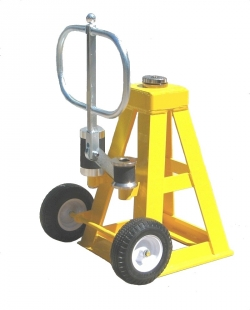
4Feed it the right air
If a jack lifts slowly, check the air supply before anything else.
Dynamic, at the jack’s air valve
Dynamic means while the jack is running. A gauge at the compressor reading 100 psi doesn’t mean the jack is getting 100 psi.
Free air, per jack
At 100 psi, Duff-Norton lists up to about 200 CFM for 100-ton jacks with no load, and 190 CFM for 50-ton jacks. Two jacks running at once need roughly twice the air.
Clean, oiled air
Duff-Norton calls for air line filter lubrication on these jacks. Run a filter and an in-line lubricator ahead of the jack.
- Air screen: The jack has an inlet air screen. Check it monthly and clear any debris.
- Hoses and fittings: Undersized or restrictive hoses, couplers and fittings starve the jack. Keep connections tight and leak-free.
5Oil and grease schedule
Duff-Norton specifies Mobil DTE Oil Light (Duff p/n X6002) or equivalent for oiling, and Mobilgrease XHP 461 or equivalent for grease.
- Remove the air motor filler plugs and fill with Mobil DTE Oil Light.
- Light oil on the standard, keys, shut-off rod and control valve parts.
- Oil the lifting screw through the hole in the standard (Mobil DTE Oil Light).
- Clean and oil the handle latch and throttle control parts.
- Remove the grease level plug, check the level and top up with Mobilgrease XHP 461.
- Heavy loads: pump Mobilgrease XHP 461 into the standard every few lifting cycles.
- Wheels: clean and grease them regularly.
- After repair or overhaul: the internal mechanism is drained, flushed and refilled with Mobilgrease XHP 461.
6Storage
- Store jacks indoors in a clean, dry place, out of rain and standing water.
- Cover them to keep out dust and grit, and keep them on a stable surface where they won’t get knocked over.
- A jack that has sat idle for a year or more must get the manual’s Frequent Inspection checklist before it goes back to work.
7Inspection and testing
The Duff-Norton manuals follow ANSI/ASME B30.1 and set these minimum inspection intervals. Shorten them if your work is hard on the jacks.
Normal service
Visual check monthly by the operator, plus a yearly inspection by a designated person, with a dated, signed record. We recommend Calumet Chicago.
Severe service
Inspect before each use or daily, and keep dated, signed records of the periodic inspections.
Every 100 lifts
Check the lifting nut and air motor blades for wear. Check more often in dirty, dusty or chip-filled environments.
- AMJ and CMJ jacks have a built-in gage that checks lifting nut wear without taking the jack apart. Older R and RX jacks need the lifting nut checked at a repair center.
- New or repaired jacks must be tested to 100 percent of rated capacity before regular use.
- Duff-Norton recommends that the yearly (periodic) inspection be done by an authorized warranty service center or other trained, authorized people. We recommend Calumet Chicago.
For OSHA inspection requirements, see our Industrial Jack Repair page.
8Signs your jack needs service
- Lifts slowly even with good air pressure and volume
- Erratic, jerky or uneven movement
- Won’t hold a load
- Oil leaking from the housing
- Scored or damaged standard, or damaged threads
- Lifting nut gage shows wear (AMJ/CMJ)
- Unusual noise from the air motor or gearbox
- Cracked housing or missing parts
Any of these means the jack comes out of service until it is repaired.
Send it to Calumet Chicago
All repairs are done in our Highland, Indiana shop. Most customers ship their jacks to us, and local pickup is available. We pay shipping both ways when you send 2 or more Duff-Norton jacks, and every repair comes with our 6-month Repair Warranty.
Request a jack repair quoteCall 708-474-2343
Monday to Friday, 7:00 to 3:30 Central.
☰Duff-Norton manuals (reference)
The full manuals are published by Duff Norton Air Motor Jack Co.: